Monday, September 28, 2009

Nothing About Love or Pity

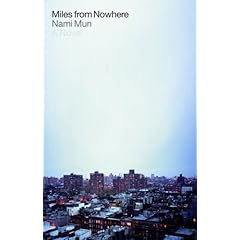
You think your life is shit, and then you read Nami Mun’s debut novel, Miles From Nowhere, and you realize you don’t even know what shit is. I read this book in a feverish haze, while sick, and reflected on the comforts of reading about other people’s misery.


(I don’t go in too often for miserable movies; I was pissed as hell at Bjork for Dancer in the Dark, but had it been a book I would have loved it.)

Miles from Nowhere is one of those books that blurbs call “gritty” and “unsentimental” and “bleak” because it deals with homelessness and prostitution, needles and relapses and misplaced love, and it deals with these things honestly. It’s an urban tale about (and by) a Korean woman who moved to the Bronx when she was a girl with a family on the edge of dissolution. It's not that you haven't heard the story before, but have you heard it from a beautiful Korean woman? Mun acknowledges the incongruity and moves on.

I still have a head full of cold, so I'm doing my favorites in bullet point style:

Joon struggles with her addiction (“I was proud of myself for having shot up exactly the right amount. Just enough to see the world without being in it.”);

She struggles with others’ expectations (“I didn’t know what to do with all their hope…Failure had better odds.”);

She struggles with her own expectations (“I had created a new life for myself but I didn’t know what to do with it. Like staring at a finished jigsaw puzzle, where the only thing left to do was mess it up again”). 

It’s maybe not your life, but it’s real life. If you don’t like it, I hear Dan Brown has a new book out.

Tuesday, September 15, 2009

the reading is the book

Rifling desperately through the galleys at my all-too-part-time bookstore gig, I came upon Nick Flynn’s new memoir, The Ticking is the Bomb.

Ok, I thought, so you can come up with some good titles. (Referencing his first memoir, Another Bullshit Night in Suck City, which I hadn’t read mostly because every other bookseller I worked with at the time had read it. I felt like the market was saturated and I should give my time to something that needed more attention. I never denied that it was a brilliant title.)

Right, so we’ve established the good titles, but the author photo is really bad. Nick Flynn, I’m sorry to have to tell you this, but you look like a bit of a douche in your author photo. And you’re a poet. And this is your second memoir. Is there really any way, I wonder, that this book is as good as the title? But, my access to fresh galleys is so short at this point I’m like a junkie, shoving all promising titles into my bag until it bulges. In you go.

I go through phases where I don’t read that much, and phases where all I do is read, and right now I’m in an intensive reading period. So I picked up Nick Flynn’s book shortly after bringing it home and opened it with a healthy dose of skepticism.

And wow. Wow. I’m sorry to be writing about this now, because it’s not published until January 2010, and I don’t really want to loan you my copy, because you won’t want to give it back, and I’m not ready to part with it. I read it too damn fast.

You probably want to know what it’s about. I’ve already said that it doesn’t matter what a book is about, but if you have to know, it’s about torture, and fatherhood. It’s about Flynn’s father and it’s about Flynn becoming a father, and it’s about Flynn’s mother’s suicide. It’s about Abu Ghraib and bearing witness. It’s about walking through addiction, about being your addiction, about giving in or not giving in to addiction. It’s about learning how to ask for help and learning how to accept it once you’ve asked. It is beautiful, excruciating, honest writing.

Whatever; I’m telling you, it doesn’t matter what it’s about. What matters is how it makes you feel. The Ticking is the Bomb blew a hole in my stomach, and then filled it, and then ran out before I was ready for it to be gone. Can you get that? Like chain smoking. Like how coffee is always gone before I know it. I wanted to run out and buy Another Bullshit Night in Suck City and read it immediately (more, I need more!), and simultaneously wanted to save it (hoarding is addictive behavior, too). I don’t want to be left with no other books by Nick Flynn to read .

Looks like I’m going to have to start reading poetry. It had to happen eventually.
  

Friday, September 11, 2009

Gidget Meets Henry Miller


I’ve been trying to write this blog post for months now. It’s been hard because it’s about someone I know and admire, and it’s about a book I really enjoyed, and I want to do it justice, I want to do her justice, and I want it to be more than a book review.

I met Reverend Jen in early 2008 at our mutual day job on the Lower East Side. I went to one of her open mic nights at Bowery Poetry Club (“If you want to see some real avant-garde theater, come to my open mic”). It was raucous and wild and everything I had imagined about New York (I’d been here maybe 4 months).

I continued attending Rev’s shows, but I felt peripheral to the Art Star scene, being new, and not an Art Star, and shy. When I heard about her book deal, I made her promise me a galley, and when I got one, I read it in three days. Live Nude Elf showed me Reverend Jen the person, the one behind Reverend Jen the personality. It’s full of sex, sure, but it’s also full of life and love and pain and passion (for art, for sex, for people).

Reverend Jen, Patron Saint of Art Stars, Patron Saint of Shy Girls, Patron Saint of Anyone Making Their Own Damn Way. Check her out (www.revjen.com), read her book, and if you're in New York, come to her open mic at Bowery Poetry on the last Wednesday of every month or visit the Troll Museum in her apartment. She’s everything you think she is, and a whole lot more, besides.

Friday, August 28, 2009

Sigh-Worthy

Just like there aren’t enough words to describe love and heartbreak and grief, there aren’t enough words to describe how a book is great. You can relate the plot of a book or the subject, and you can talk about style and tone and point of view and lyricism, but a book is really about how it makes you feel. Feelings are not as easy to talk about, so books get boiled down into clichés and sound bites when actually, they are experiences.

A co-worker and friend recommended a book recently, The Last of Her Kind, by Sigrid Nunez. I could see that she was excited by this book, but the description didn't appeal to me, so I hesitated to pick it up. A while later we were working together when a stack of this book came in for her staff pick. I'd forgotten all about the book, but her wistful smile let me know this was a book she really loved. "Oh, this is your staff pick, right? The one you were telling me about?" She said yes, and then she just smiled and sighed. It was the sigh that convinced me.

In her sigh, she expressed the often futile desire to describe how a book made you feel. What you really want to say is “read this book, please. I promise you will love it. This book touched something inside me and struck a note that still vibrates, and I want you to read it and have that same note sing in you as well. Just trust me.” That little sigh was as close as she could get to expressing her love for this book.

When I'm recommending books, people inevitably want to know what the book is about. I give as short an answer as possible and point out that it doesn’t matter what the book is about. Then I offer an anecdote about how I felt reading the book. The Ministry of Special Cases had tears dripping from my eyes as I stood outside on the corner, late coming back from my lunch break. Madeleine is Sleeping was like being in on a great secret. The Raw Shark Texts had my heart racing like a drug; I couldn’t put it down on the two mile walk from the train to my apartment in DC. And etcetera.

But there’s only so much you can say, only so many times you can say it. Sometimes all you can do is smile and sigh.

Sunday, August 16, 2009

Oh kindle, How I Love to Hate You

If we’re friends on the facebook then you already know about my anti-kindle crusade (in an attempt to belittle, I refuse to capitalize “kindle”). It’s been pretty effective. So far I have kept one person from buying a kindle. That was my mother. Amazon is on its knees.

In theory, the kindle is akin to Oprah’s Book Club. I’m for anything that gets people to read more, no matter what they’re reading or how they’re reading it. Personally, however, I’ve never been so against any technology, and I’m not what you’d call a techie.

One night at a party a sales rep for a reputable publisher and I debate the kindle and try to outdo each other with self-righteousness. She finds herself reluctantly accepting the kindle as a tool of her trade. I concede that the kindle is a book in that a book is a collection of words, I agree that an author probably doesn't care how their book is ingested (although I would--wouldn't I?), I agree that the kindle is a good tool for reading many books quickly (but so is a nice sturdy tote). But semantics aside, a kindle is not a book, not really. As a bookseller (not a publisher), I have the luxury to be snotty about the kindle. I can hate the kindle with no remorse. It is a tool I do not need.

When my mother called me at 7:30 in the morning to tell me she was considering buying a kindle, I knew she was weighed down with guilt. I recited all the reasons she should be against the kindle. It doesn’t have pages (those aren’t pages), you can’t flip back to a sentence by muscle memory, it’s less friendly to being hugged in joy or thrown at the wall in anger, it doesn’t have a smell.

But for travelling, my mother counters, think of how wonderful it would be to bring as many books with you as you wanted and not having to choose only one or two because of the weight! Yes, I agree, but think of this: you’re on an airplane over the ocean, you’re in the middle of the new Stieg Larsson book, you haven’t been this excited by a book in ages, and all of a sudden, the battery on your sweet little kindle dies, you forgot to put the charger in your carry on, and you have no more books. Mother gasps. Books don’t disappear, Mom.

Kindle’s new ad on Amazon claims “Kindle reads like real paper, even in sunlight. Beach reading never looked so good." Only, don't get sand in it, spill a drink on it, or leave it sitting in direct sunlight. Kindle, like Pinocchio, dreams of being real.

Later that day I received an email from my mother:
Subject: Kindle
I REPENT!!!!! FORGIVE ME!!!!!! IT WAS TEMPORARY INSANITY. Mom.
The crusade goes on.

Wednesday, August 5, 2009

Reader's Block

I haven’t had a good book to read in what feels like months. I’ve been reading short stories and articles and read a good-enough book on vacation, but I haven't been really satisfied by a book in a while. Finally I diagnosed myself with Reader's Block and prescribed a classic.

Never having read Cormac McCarthy, I started with All the Pretty Horses and was stunned, by page forty-three, at it’s beauty. I hadn’t assumed such lyricism by an author I associated with stark masculinity and grotesqueries like The Road and No Country for Old Men. If I were to guess, before I began this book, I would have assumed his style would be straightforward, in your face, even. Based on nothing, really. Based on the movie version of No Country.

But I was wrong, and from the first page, from the repetition of dark and cold and no wind and the long sentences like rolling hills and the lack of punctuation, commas sparse as Texas trees in my East-coast mind, I’ve been charmed by McCarthy's spell.

This kind of writing is exciting to me, it raises my body temperature and makes my heart beat faster. Do yourself a favor and read this passage out loud:

They heard somewhere in that tenantless night a bell that tolled and ceased where no bell was and they rode out on the round dais of the earth which alone was dark and no light to it and which carried their figures and bore them up into the swarming stars so that they rode not under but among them and they rode at once jaunty and circumspect, like thieves newly loosed in that dark electric, like young thieves in a glowing orchard, loosely jacketed against the cold and ten thousand worlds for the choosing.

And that's just one sentence. It’s the kind of sentence you have to read aloud; I whispered it while reading and walking down my block and again, louder, as soon as I got home. This sentence reminds me of a passage from Midnight’s Children which is too long to quote here but spirals up and down around a green and black witch. Poetry. My faith in books is restored.

Monday, April 27, 2009

This is how I read.

I don't ever read the backs of books. At best, it gives me no idea of the author's writing, and at worst it can ruin the plot. What a book is about isn't as important as my emotional response to reading it. You have to trust the author enough to just start reading.

I know, books aren't cheap, and you've got to have some way of narrowing the field. You have little choice but to judge a book by its cover, and more importantly its title, and, let's be honest, probably the author's photo. Once it's passed these tests, open it and read the first sentence, the first paragraph, the first page. Sometime you'll know by the first sentence. If you're interested enough to turn the page, standing in a bookstore, you should probably buy it. 

Which brings us to another point, which is: Ask a bookseller (or a friend, but booksellers need the work). There's hopefully an independent bookstore near your home, with a quirky staff just waiting to flex their intellects in your direction. A friend says she's intimidated to ask booksellers for recommendations, and I can see that; there are those whose puffed up brains get the better of them, but most of us are friendly if slightly socially awkward. And don't buy books online (if you don't have to). Books aren't that expensive, and you're not really that lazy. 

Also important: If you aren't enjoying a book, stop reading it. As long as you haven't spilled coffee on it or ripped off the cover, you can take it back. There are too many great books in the world to keep reading one that doesn't do it for you.

Some examples of books I've chosen based on the cover and/or title:
Jonathan Strange and Mr. Norell (the galley was two toned black and white with magic symbols)
Sacred Games (also the galley-it had a gold spine and a slipcover with bullet holes. I'm a sucker for a slipcover)
The Raw Shark Texts (every bit as kick ass as the title)
The Girl on the Fridge (very weird, very short stories)
The Glass Books of the Dream Eaters (nowhere near as cheesy as it sounds)

Alternatively:
 I refuse to read any book with wife or daughter in the title. And there are so many of them to  reject:
American Wife, The Senator's Wife, The Zookeeper's Wife
The Memory Keeper's Daughter, The Heretic's Daughter, The Abortionist's Daughter
 I cut a sideways deal with The Time Traveler's Wife, which I listened to on CD after many many. It was great, but I still think this is lazy titling.

A short selection of really great beginnings:
"Grandpa Slavko measured my head with Granny's washing line, I got a magic hat, a pointy magic hat made of cardboard, and Grandpa Slavko said: I'm really still too young for this sort of thing, and you're already too old." How the Soldier Repairs the Gramophone, by Sasa Stanisic 

"The beet is the most intense of vegetables. The radish, admittedly, is more feverish, but the fire of the radish is a cold fire, the fire of discontent not of passion. Tomatoes are lusty enough, yet there runs through tomatoes an undercurrent of frivolity. Beets are deadly serious." Jitterbug Perfume, by Tom Robbins

"Early in the morning, late in the century, Cricklewood Broadway. At 0627 hours on January 1, 1975, Alfred Archibald Jones was dressed in corduroy and sat in a fume-filled Cavalier Muskateer Estate facedown on the steering wheel, hoping the judgment would not be too heavy on him." White Teeth, by Zadie Smith

"In accordance with the law the death sentence was announced to Cincinnatus C. in a whisper."Invitation to a Beheading, by Vladimir Nabakov

"On July 26, 1971, while legendary photographer Diane Arbus was curled in a bathtub at the Westbeth apartments in New York City, slitting her wrists, Bob Langmuir was travelling out of his body, which was heaped in a roadside ditch in rural Vermont, struggling to maintain its own hold on life." Hubert's Freaks, by Gregory Gibson

This last one I just found today. I can't wait to read it.