Monday, April 27, 2009

This is how I read.

I don't ever read the backs of books. At best, it gives me no idea of the author's writing, and at worst it can ruin the plot. What a book is about isn't as important as my emotional response to reading it. You have to trust the author enough to just start reading.

I know, books aren't cheap, and you've got to have some way of narrowing the field. You have little choice but to judge a book by its cover, and more importantly its title, and, let's be honest, probably the author's photo. Once it's passed these tests, open it and read the first sentence, the first paragraph, the first page. Sometime you'll know by the first sentence. If you're interested enough to turn the page, standing in a bookstore, you should probably buy it. 

Which brings us to another point, which is: Ask a bookseller (or a friend, but booksellers need the work). There's hopefully an independent bookstore near your home, with a quirky staff just waiting to flex their intellects in your direction. A friend says she's intimidated to ask booksellers for recommendations, and I can see that; there are those whose puffed up brains get the better of them, but most of us are friendly if slightly socially awkward. And don't buy books online (if you don't have to). Books aren't that expensive, and you're not really that lazy. 

Also important: If you aren't enjoying a book, stop reading it. As long as you haven't spilled coffee on it or ripped off the cover, you can take it back. There are too many great books in the world to keep reading one that doesn't do it for you.

Some examples of books I've chosen based on the cover and/or title:
Jonathan Strange and Mr. Norell (the galley was two toned black and white with magic symbols)
Sacred Games (also the galley-it had a gold spine and a slipcover with bullet holes. I'm a sucker for a slipcover)
The Raw Shark Texts (every bit as kick ass as the title)
The Girl on the Fridge (very weird, very short stories)
The Glass Books of the Dream Eaters (nowhere near as cheesy as it sounds)

Alternatively:
 I refuse to read any book with wife or daughter in the title. And there are so many of them to  reject:
American Wife, The Senator's Wife, The Zookeeper's Wife
The Memory Keeper's Daughter, The Heretic's Daughter, The Abortionist's Daughter
 I cut a sideways deal with The Time Traveler's Wife, which I listened to on CD after many many. It was great, but I still think this is lazy titling.

A short selection of really great beginnings:
"Grandpa Slavko measured my head with Granny's washing line, I got a magic hat, a pointy magic hat made of cardboard, and Grandpa Slavko said: I'm really still too young for this sort of thing, and you're already too old." How the Soldier Repairs the Gramophone, by Sasa Stanisic 

"The beet is the most intense of vegetables. The radish, admittedly, is more feverish, but the fire of the radish is a cold fire, the fire of discontent not of passion. Tomatoes are lusty enough, yet there runs through tomatoes an undercurrent of frivolity. Beets are deadly serious." Jitterbug Perfume, by Tom Robbins

"Early in the morning, late in the century, Cricklewood Broadway. At 0627 hours on January 1, 1975, Alfred Archibald Jones was dressed in corduroy and sat in a fume-filled Cavalier Muskateer Estate facedown on the steering wheel, hoping the judgment would not be too heavy on him." White Teeth, by Zadie Smith

"In accordance with the law the death sentence was announced to Cincinnatus C. in a whisper."Invitation to a Beheading, by Vladimir Nabakov

"On July 26, 1971, while legendary photographer Diane Arbus was curled in a bathtub at the Westbeth apartments in New York City, slitting her wrists, Bob Langmuir was travelling out of his body, which was heaped in a roadside ditch in rural Vermont, struggling to maintain its own hold on life." Hubert's Freaks, by Gregory Gibson

This last one I just found today. I can't wait to read it.

Monday, April 6, 2009

New York Baby

I'm still a New York baby. Or maybe I'm a New York toddler now, I'm not really sure about the conversions. At any rate, it was a hard birth, with lots of kicking and screaming. I read this book as I was making plans to move north from DC, which is fitting, as it's about a young woman who moves to New York. I wrote this review a month before I moved, as I was interviewing for a publishing job, which I got, and then hated, and then quit. I didn't quit New York, though, and come summer I was glad I stayed. Here it is, unedited:

Aoibheann Sweeney’s debut novel, Among Other Things, I've Taken Up Smoking, is an enchanting book of changes. After her mother’s death, Miranda lives in near seclusion with her father on a private island off the coast of Maine. A lonely child, Miranda is preoccupied with the myths from Ovid’s Metamorphoses, a translation of which makes up her father’s life work. The tangled fates of god and mortals begin to crowd Miranda’s consciousness and these stories take the place of more substantial relationships. She is obsessed by the idea that, like these supernatural figures, she too would become “marvelous like they did in the stories Ovid told, and become something else.”

As Miranda grows into womanhood, she leaves her island for another that is more densely populated but sometimes equally lonely: Manhattan. In New York, however, her relationships become more complex and eventually more sophisticated. Sweeney’s use of myths mirrors Miranda’s developing character as Miranda realizes that “the tales in Metamorphoses rarely ended happily; the process of transformation…was mostly a compromise of some sort, a way to negotiate the chasm between desire and mortality.” As she learns to negotiate her own chasm, Miranda’s greatest transformation is the realization that she can affect her own metamorphosis.

The review reads like fluff to me now (enchanting? negotiate her own chasm? I mean, really); the connection between Miranda's journey and my own desire for transformation seems blatant. I was stepping into a great unknown, without much of a net, and I was thrilled with my bravery but also terrified that I would die of loneliness, that I would never make a friend or feel safe or loved again. I got over it. I've always had a high ratio of alone time, but I've never felt so comfortable being alone as I do in New York. I think the ability to blend in, to be alone among so many was part of what drew me here.

Among Other Things, I've Taken Up Smoking meant a lot to me because it was about a New York baby just like me, all on her own, half dysfunctional but making it work. Aoibheann Sweeney knows how to talk about solitude, with the right mixture of freedom and melancholy. Plus I'm jealous of the title. It's a great, quiet book.

Sunday, March 29, 2009

Galley Surfing

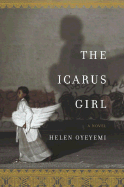
I got all excited yesterday at the bookstore when I came across a galley of the new novel by Helen Oyeyemi. I haven't read it yet, but it reminded me how much I love her peculiar fiction. It's all storytelling and magical realism, but with a sinister undertone.

Her first book, The Icarus Girl, is dedicated to "Mary Oyeyemi, (Sorry about that time I pretended to be the Angel of Death.)" The novel's protagonist, Jessamy, is shy; not the kind of girl you can imagine would play at being an instrument of destruction. Visiting her mother's family in Nigeria for the first time, Jessamy meets TillyTilly, a character more in line with the antics of Oyeyemi's dedication. TillyTilly appears again when Jessamy returns to England and the relationship gets a little scary.

Granted, I'm a sucker for a novel about a screwed up little kid. I just eat that shit up, and then you add magical realism and weird psychology, not to mention Nigerian mythology, and I'm all over it. And then, it's also well-written, remarkably so, since she wrote it when she was 19 and in college.

Oyeyemi's books have this earthy quality to them. Even though a lot of weird shit is going on, it's presented in this heavy kind of way. She tells her stories with the conviction of the ages, like she's been telling these stories her whole life, young as she is.

I'll report back on Helen Oyeyemi's third novel, White Is For Witching, when it comes out in June.

Wednesday, March 18, 2009

Scary-Time Tempers


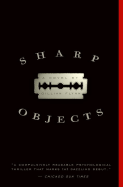
Holy Christ, this book just hit me like a—like some kind of big truck or train or something. I turned down two invitations to sit at home and read this book; I couldn’t be bothered to think about anything else. I carried it to the bathroom with me, I read it walking to and on and from the train, I tripled checked the locks on my doors and stayed up until three in the morning. And then, of course, it was over too soon, and I miss it, like an addiction.

The book is Sharp Objects, by Gillian Flynn, and I'm two years late. It's a murder mystery, the main character is a journalist, on assignment to return to her hometown to report on the murders of two young girls, but the details aren't really that important. I mean, they are, but here's what everyone wants to talk about with this book:

Camille Preaker (the journalist) is a cutter. She has cut words all over her body, save for her face and hands, and a circle in the middle of her back she couldn’t reach. Six-months in recovery, she still jams wood staples into her fingernails and scrapes her palms with any hard edge in sight. She traces words in ballpoint on her forearms, her thighs, until they are raw.

That Camille Preaker is a cutter is important, but what’s more important is that Camille Preaker is fucking real. She has real thoughts and needs and they are not all nice and they are certainly not pretty and she fucks up a lot while dealing with life in a way that is completely true. She drinks too much, she does drugs (with her underage sister), she has unrepentant sex. But she also meets deadlines and pays her bills and takes care of her shit. She is holding her edges together, tenuously. She is full of contradictions, and Gillian Flynn makes no apologies for her.

Gillian Flynn writes about hatred and darkness and she lets her characters be honest. She writes about girls with “serious tempers, like scary-time tempers, like boy tempers.” She writes about the dangerous fury that festers in neglected and children of privileged families, but you don’t really get the feeling she feels too sorry for them (“being conflicted means you can live a shallow life without copping to being a shallow person.”). She presents her characters with all their flaws and complexities and lets them judge themselves.

Monday, March 9, 2009

What I Talk About

Writing and running are the two things I feel the most passionate about. I’m not that great at either of them, but Haruki Murakami more than makes up for my shortcomings. I love the way that Murakami talks about what he talks about when he talks about running.

That sounds trite and canned, and what I’m trying to say is that I’m really loving this book, What I Talk About When I Talk About Running, by Haruki Murakami. He’s one of my favorite novelists, who started running and writing at the age of 33. This gives me hope—I am only 30! He didn’t even start until three years after me, and he has since run in 24 marathons. He has also written I don’t know how many novels and short stories, some of my favorite books. This gives me hope—for being able to impose and respond to discipline in craft and physique.

I learned discipline early, from my mother and from ballet. The rigid discipline of ballet wasn’t foreign to me, and the exactitude of the art form made sense to me. It was right that everything had a rule, every body part a correct and an incorrect placement, movement, timing. The rules were clear, and if I followed them I would do well. It was the same at home. These are the jobs, these are the rules; step out of line and face the consequences.

As with writing and running, so with ballet and chores; I was never that great at the follow-through. The difference between writing and ballet, however, is the amount of human interaction necessary to perform. I love ballet and would love to take a dance class again. Being thirty and curvy, however, I fear being judged by the teacher and other students.

No one has to know that I’m writing, though. I am free to practice in private, away from judgmental eyes, at little to no cost. Running shares this quality of solitude. I don’t have to join a gym to run, especially since I prefer running outside to running inside. Out of fear, I protect the things I don't want to live without.

My difficulty is imposing discipline on myself. Running doesn’t have as many rules as ballet, and even if it did I don't think I would care. I just know that when I’m running is the one time that I always feel okay about life. There are many times, times when I am standing still, that I feel so bad that I can’t even drum up the encouragement to go running. The automatic GO switch inside me shorts out when the apathetic haze gets thick. Since I haven’t been able to commit to running every day, I haven’t built my stamina or speed much at all, and I haven’t developed a runner’s body to help me do that.

It’s the same with writing. I feel right when I’m writing, and I’m always writing in my head, no matter where I am. It’s harder to sit down and write every single day, or even most days. I’ve started practicing, I’ve started flexing, but I haven’t committed yet.

Murakami’s writing and running habits are absolutely different from my own; he does both very nearly every single day. And because of this absolute dedication, he has been very successful at both of them. Very accomplished. But he didn’t start until he was thirty-three. There is still time.